Time Zone Dynamics Driving Participation Patterns in International Texas Hold'em Competitions
Written by Lars Becker · Jul 11, 2026

Time Zone Dynamics Driving Participation Patterns in International Texas Hold'em Competitions
Time zone variations create distinct windows that shape when players from different continents log into international Texas Hold'em events, and data from major online platforms shows clear spikes in entries from Asia during evening hours that align with morning schedules in Europe and the Americas. Observers note that these alignments determine not only entry volumes but also the composition of tables, since participants in distant regions face sleep disruptions or work conflicts that filter who joins specific sessions. Research from gaming analytics firms indicates that tournaments scheduled between 8 PM and midnight UTC attract higher percentages of entrants from the Asia-Pacific region, while those starting at 2 PM UTC draw more heavily from North American time zones where afternoon availability remains strong.How Scheduling Aligns with Regional Daily Rhythms
Operators adjust start times to balance global access, yet the underlying geography means that a single event rarely suits every major player base equally. When an Australian series opens at 10 AM AEST, European players encounter early morning slots that reduce their numbers, whereas North American participants often find late evening opportunities that boost their engagement. Figures from tournament databases reveal that events crossing the International Date Line experience staggered registration peaks, with Asian players frequently completing entries first due to favorable local hours, followed by later surges from the Americas as their workdays conclude.
July 2026 data from cross-platform operators highlights this pattern during the summer festival circuit, where multiple series overlapped across time zones and produced measurable shifts in daily participation graphs. One operator reported that sessions beginning at 6 PM UTC saw 35 percent of entries originate from players in Japan, South Korea, and Australia, while the remaining share came from Europe and the Americas in roughly equal parts once adjusted for population sizes of active accounts.
Impact on Multi-Table and Endurance Play
Players managing multiple tables across time zones often encounter fatigue thresholds that alter decision speed and risk tolerance as local night extends into early morning. Studies of session logs demonstrate that participants from western time zones who join late-evening events for eastern audiences maintain shorter average session lengths compared with those whose local clocks remain in daytime ranges. This difference appears consistently in aggregated statistics, where endurance metrics drop after four to six hours when biological night coincides with active play periods.
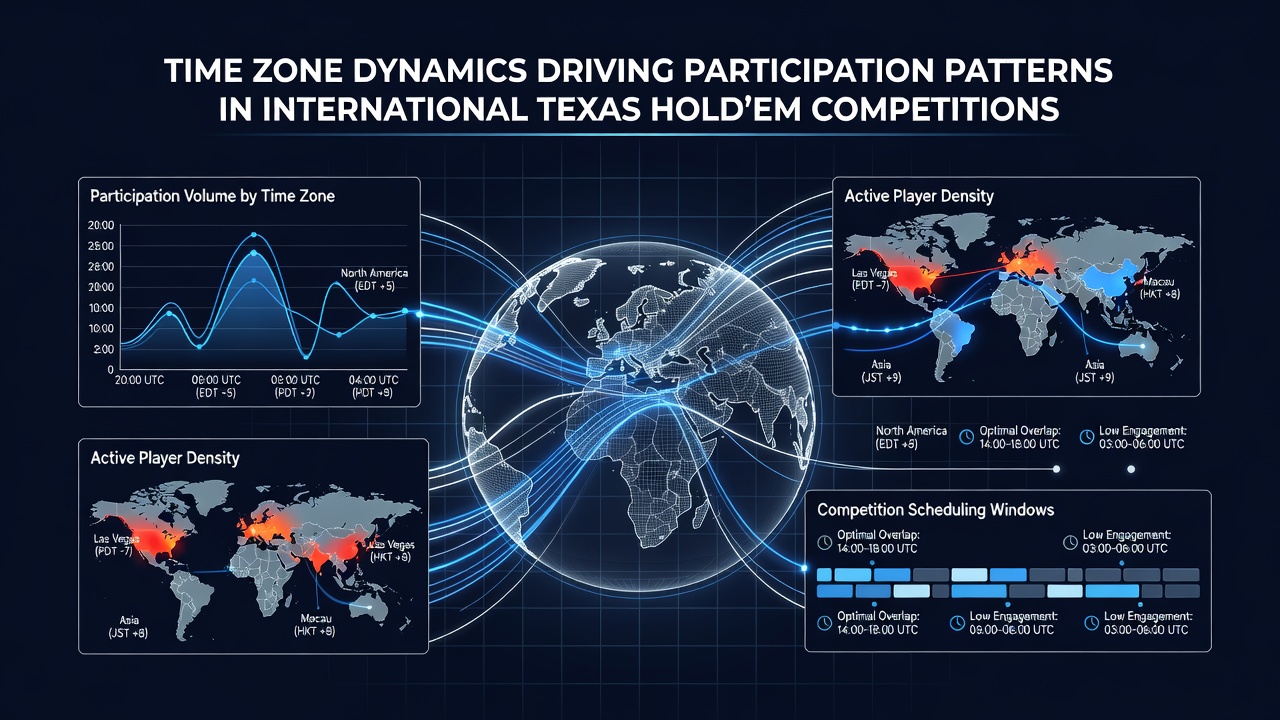
Those who study these patterns find that certain regions develop preferred tournament clusters, such as Southeast Asian players concentrating on events that finish before 2 AM local time to preserve next-day productivity. North American cohorts similarly cluster around late-afternoon starts that finish before midnight in their zones, creating natural segmentation in field sizes across the weekly calendar.
Platform Adjustments and Data Trends
Platform operators respond by publishing start-time calendars that incorporate time-zone converters and regional filters, allowing players to identify events that fit their schedules without manual conversion. According to reports compiled by the European Gaming and Betting Association, these tools correlate with increased retention rates among international users who previously missed events due to misaligned hours. Canadian regulatory filings from provincial gaming commissions further show that time-zone-aware scheduling contributed to measurable growth in cross-border entries during the first half of 2026.
What's interesting is how these adjustments interact with prize pool structures, since larger fields often form when multiple time zones contribute simultaneously. Data indicates that events drawing from at least three major zones produce average field sizes 22 percent larger than those limited to two zones, a pattern tracked across dozens of weekly series on major sites.
Regional Examples and Calendar Effects
Take one documented case from a global series in July 2026 where an event scheduled at 4 AM AEST attracted minimal Australian participation yet filled rapidly with entrants from the Americas during their afternoon hours. Observers recorded that the resulting table dynamics reflected this skew, with strategy adjustments appearing more conservative among players operating outside their optimal alertness windows. Similar observations appear in academic examinations of online gaming behavior, where chronotype influences receive attention alongside traditional skill metrics.
Another pattern emerges around daylight saving transitions, when abrupt one-hour shifts temporarily disrupt established entry rhythms until players recalibrate. Records from multiple operators show brief dips in participation from affected regions during the weeks following these changes, followed by recovery as routines stabilize.
Conclusion
Time zone considerations continue to influence entry volumes, table compositions, and session durations across international Texas Hold'em competitions, with operators and players alike adapting through scheduling tools and selective participation. Data collected through 2026 demonstrates consistent regional preferences that operators track to optimize event calendars and maintain balanced fields. These dynamics remain central to how global poker circuits distribute opportunities across continents.